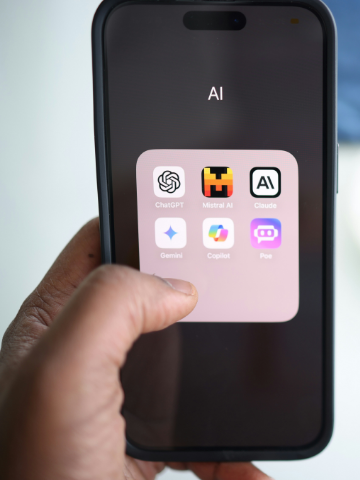
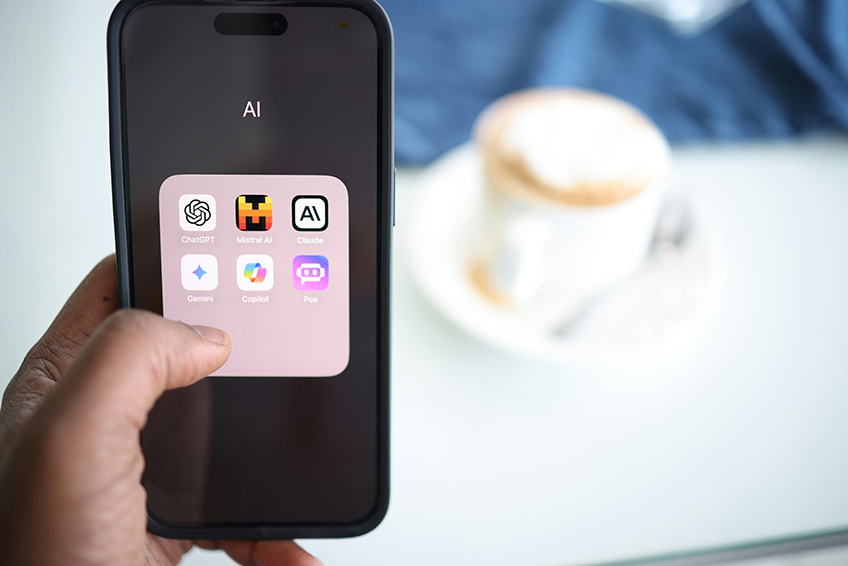
The novelty phase of AI has officially passed. In 2026, it’s no longer about whether to use AI, but how to integrate it into your workflow without adding more “dashboard fatigue” to your morning.
At our web design agency, we’ve been putting some of the “top” tools to the test. Some have become indispensable daily partners; others, frankly, haven’t lived up to the marketing hype. Here is an honest look at our current toolkit.
Gemini (Google) – The All-Rounder
Gemini has become our go-to for heavy lifting. It excels at handling brand tone and is particularly fast at summarising long-form content, drafting documents, and composing emails. We find the conversational UI feedback loops perfect for brainstorming. Its free version is really very good, virtually no limitations. Top Tip: Tweak the settings to instruct it to use UK language and not to use em-dashes! The Verdict – excellent for drafting, but it still requires human oversight for complex tasks.
Yoast AI – The “GEO” Specialist
Search behaviour is shifting towards Generative Engine Optimisation (GEO). We have used Yoast AI specifically for generating high-quality metadata and identifying “key takeaways” on blog posts. This doesn’t just help with traditional SEO; it ensures our content is structured for AI citations and summaries. Above all, it is a massive time saver. Tasks that previously took hours to draft and approve manually now take only minutes.
Otter.ai – The Meeting Memory
Otter remains a staple for transcribing meetings and providing instant action points. It is highly accurate at capturing the flow of a conversation, allowing us to focus on the client rather than taking notes. We’d love to use it more, but having the ‘AI Agent’ present in meetings isn’t always appropriate.
Claude (Anthropic) – For Nuance
When a brief is complicated or an article needs a thoughtful, conversational touch, you can turn to Claude. It often handles nuance better than other models, making it ideal for longer, more sensitive editorial pieces.
ChatGPT & Co-pilot – The Sliding Scale
While these were the original trailblazers, they have started to slip in our rankings. We’ve found increasing issues with accuracy, being out of date and “hallucinations”. They remain useful for quick, low-stakes tasks, but they no longer hold the top spot for our critical drafting work. Of course these also come with a premium subscription, which is a downfall for smaller organisations.
Midjourney (V6+) – Visual Consistency
For campaign imagery that looks polished rather than generic, Midjourney is still the leader. It allows us to maintain a consistent visual style across social content, provided you have a human eye to guide the prompt. Again, a subscription is needed.
The Web Design Reality Check
We’ve been testing the “top of the market” AI web builders. While they are impressive as tech demos, our experience shows they aren’t quite ready to replace the professional.
Lovable – Fast Prototyping
Lovable is great for spinning up a quick React app or a functional prototype. However, it can get stuck in “looping” errors when things get complex, and the code it produces can be difficult for a human developer to jump in and fix.
While Lovable is built on open standards that allow for full code export via GitHub, it remains a managed environment by default. For those who choose to stay within the platform for its ease of use, there is a natural trade-off: you gain rapid, AI-driven iteration, but you become reliant on their specific ecosystem to maintain that speed. Moving the project to independent hosting is entirely possible, but doing so shifts the responsibility of maintenance and scaling back to your own technical team, removing the “magic” of the automated AI builder.
ZipWP – The WordPress Shortcut
This is one of the fastest ways to get a “first draft” WordPress site. It’s useful for testing a layout, but you’ll find yourself spending just as much time adapting and branding it as you would starting from scratch with a solid wireframe.
Framer AI – Beautiful but “Salesy”
Framer’s AI is fun for landing pages, but it tends to spit out generic, promotional copy that lacks soul. It’s a great design tool, but the AI-generated starting points often feel formulaic and require significant manual tweaking to meet real user requirements.
Crucially, Framer is a closed ecosystem with no native code export, meaning you are permanently tied to their hosting. This lack of an open-source framework creates a “walled garden” effect where you don’t truly own the underlying asset, making it difficult to migrate or customise the code independently in the future.
Quick Fact Check: Unlike Lovable (which syncs to GitHub), Framer is strictly “proprietary.” If you stop your subscription, you cannot simply download your site to host it elsewhere.
Visual Studio AI – The Developer’s Hindrance
We’ve found that even in high-end environments like Visual Studio, AI can sometimes be more of a hindrance than a help—throwing in inline code you don’t want or breaking useful features like autocomplete. It’s a reminder that AI is still a tool, not a replacement for a developer.
Final Thoughts on AI tools in 2026: Speed vs. Sovereignty
The most advanced tool isn’t always the best one, and although it can feel like a magic wand solution, it usually comes with a price of some sort. The winners are the tools that support us as strategists and do the heavy crunching without fees. AI has a long way to go before it can match the intuition of a real designer or developer, and as many are probably finding out the hard way, there are no shortcuts to quality, human-led design and change management workflow and cost.
About the Author
Karen Oliver, Managing Director
 Since 2009, Karen has directed the creative strategy and UX design vision for the agency. Clients value her unique ability to bridge the gap between high-level business goals and technical execution. With 25 years of experience across SEO, project management, and design strategy, she ensures that every digital asset – AI-assisted or otherwise – is built with purpose, precision, and long-term sovereignty in mind.